mera saaya
Feb. 9th, 2009 08:24 pm![[personal profile]](https://www.dreamwidth.org/img/silk/identity/user.png) lobelia321
lobelia321I saw Mera Saaya (My Shadow).
Director: Raj Khosla.
Stars: Sadhana, Sunil Dutt.
Date: 1966.
Music director: Madan Mohan.
Playback singers: Mohammed Rafi, Asha Bhosle, Lata Mangeshkar.
This film featured Sunil Dutt. Here is he:

I have only seen Sunil Dutt in other film, Mother India (he plays the wayward son of Nargis). He got on my nerves in that film but I quite liked him in Mera Saaya. He has a solid, serious screen presence, and I liked his dashing cowlick, his brylcreemed hair and his shadowed eyes.
The woman in the film is Sadhana. I had never seen a film with her. Each of her teeth is separated from the next by a little space which I found distracting.
What is fascinating is Sadhana's dual role. She plays a dacoit bandit vamp and a dutiful sweet housewife.

Dutiful housewife
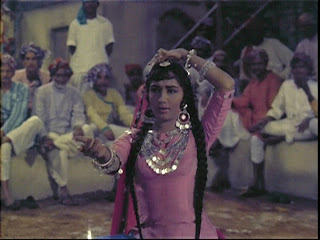
Wantonly dancing bandit queen
The plot: Sunil arrives home from a trip abroad only to find Sadhana dying in his arms. She is cremated. A bandit woman is arrested; she is accused of, some time earlier, having distracted some village men with her wanton dancing while her accomplices robbed and pillaged. The arrested woman protests her innocence. She looks identical to the dead dutiful housewife and, in fact, claims to be that dutiful housewife. Sunil says, nonsense, you desecrate the memory of my wife. A trial ensues. Matters get complicated. One minute you find yourself disbelieving everything the obviously lying bandit woman cheat is claiming. The next minute, after some clever plot twistings, you find yourself believing that somehow, miraculously, the dutiful wife has risen from the dead. All of this is driving Sunil mad although he resists with manly lawyer-ness. The end is Hitchcockesque in its convolutions.
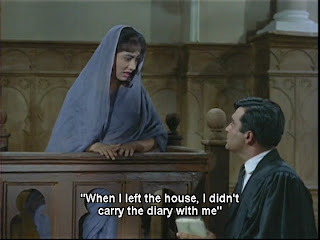
In the courtroom at the trial.
Now what is fascinating is this:
Sadhana plays both roles. As dutiful wife, her songs are voiced by Lata Mangeshkar, the nightingale with the pure voice. As bandit queen, her wanton song-dance is voiced by Asha Bhosle, Lata's sister but the one who tended to be used to voice vamps and tarts with a heart. As one director put it, 'Asha has more of the market in her voice'. Now, spectators of this film see Sadhana/hear Lata in some scenes, and in others they see Sadhana/hear Asha.
This sets up in our, the spectators', minds the strong idea that these are two separate people: bandit queen/Asha versus housewife/Lata, the raunchy wicked one vs the pure one.
In addition, there are several song sequences in which Sunil mopes around in his home, gauzy curtains fluttering, the record player playing Sunil's dead wife's singing: "Mera Saaya..." The songs are sung by Lata Mangeshkar. But they are not picturised on anybody. The camera roams through empty rooms and pavilions: it shows us an architecture imbued with the spirit of dutiful wife/Lata. But we don't see the wife; we don't see Sadhana the actress; we hear only Lata's disembodied ethereal singing.
I have no image of this but the clip is on youtube: Clip of the song Nainon Mein Badra Chhaye.
It starts out with music over shots of beautiful architecture (a hotel on a lake but I've forgotten what lake). Then we have a close-up of Sunil, looking rather dapper and tormented, as Lata begins to sing. This is song-as-memory. We see Sunil but we hear Lata. His lips don't move so it's clear he's not lipsynching; this signifies his interior life, memories, dreams, all filled with dead wife/Lata.
Then we cut to a scene of Sunil and Sadhana in this beautiful architecture. This is a flashback: now Sunil's memory is not only auditory but visual as well.
Finally, we're back in the present with the empty pavilion. It's a gorgeous and very clever use of song/imagery, audio/visual. It shows in an exemplary fashion how songs in Bollywood movies can fulfill a whole range of functions and how can they can be complexly constructed as well as furthering the narrative in interesting ways.
This song is also quite lovely and really grew on me after a while.
Oh, and here's the wanton vamp dance:
Clip of Jhumka Gira Re.
Listen for Asha's voice and what a difference it makes to the effect of Sadhana's performance and screen presence.
I couldn't find a clip or pics of the wonderful gauzy-curtains scene.
Also, this is the first Bollywood film that actually made my hair stand on end at one point. I've never been scared in a Bollywood film!! I do get scared easily, I hasten to add, but still!!
Finally, Madan Mohan who wrote the music is also the composer of Veer-Zaara, a more recent film whose music I love more than its visuals! (Although they are also not bad...) The film was a posthumous tribute to some music that Mohan had left unfinished at his death so they resurrected and re-arranged it all and used it. And Lata sang them once again.
Director: Raj Khosla.
Stars: Sadhana, Sunil Dutt.
Date: 1966.
Music director: Madan Mohan.
Playback singers: Mohammed Rafi, Asha Bhosle, Lata Mangeshkar.
This film featured Sunil Dutt. Here is he:
I have only seen Sunil Dutt in other film, Mother India (he plays the wayward son of Nargis). He got on my nerves in that film but I quite liked him in Mera Saaya. He has a solid, serious screen presence, and I liked his dashing cowlick, his brylcreemed hair and his shadowed eyes.
The woman in the film is Sadhana. I had never seen a film with her. Each of her teeth is separated from the next by a little space which I found distracting.
What is fascinating is Sadhana's dual role. She plays a dacoit bandit vamp and a dutiful sweet housewife.
Dutiful housewife
Wantonly dancing bandit queen
The plot: Sunil arrives home from a trip abroad only to find Sadhana dying in his arms. She is cremated. A bandit woman is arrested; she is accused of, some time earlier, having distracted some village men with her wanton dancing while her accomplices robbed and pillaged. The arrested woman protests her innocence. She looks identical to the dead dutiful housewife and, in fact, claims to be that dutiful housewife. Sunil says, nonsense, you desecrate the memory of my wife. A trial ensues. Matters get complicated. One minute you find yourself disbelieving everything the obviously lying bandit woman cheat is claiming. The next minute, after some clever plot twistings, you find yourself believing that somehow, miraculously, the dutiful wife has risen from the dead. All of this is driving Sunil mad although he resists with manly lawyer-ness. The end is Hitchcockesque in its convolutions.
In the courtroom at the trial.
Now what is fascinating is this:
Sadhana plays both roles. As dutiful wife, her songs are voiced by Lata Mangeshkar, the nightingale with the pure voice. As bandit queen, her wanton song-dance is voiced by Asha Bhosle, Lata's sister but the one who tended to be used to voice vamps and tarts with a heart. As one director put it, 'Asha has more of the market in her voice'. Now, spectators of this film see Sadhana/hear Lata in some scenes, and in others they see Sadhana/hear Asha.
This sets up in our, the spectators', minds the strong idea that these are two separate people: bandit queen/Asha versus housewife/Lata, the raunchy wicked one vs the pure one.
In addition, there are several song sequences in which Sunil mopes around in his home, gauzy curtains fluttering, the record player playing Sunil's dead wife's singing: "Mera Saaya..." The songs are sung by Lata Mangeshkar. But they are not picturised on anybody. The camera roams through empty rooms and pavilions: it shows us an architecture imbued with the spirit of dutiful wife/Lata. But we don't see the wife; we don't see Sadhana the actress; we hear only Lata's disembodied ethereal singing.
I have no image of this but the clip is on youtube: Clip of the song Nainon Mein Badra Chhaye.
It starts out with music over shots of beautiful architecture (a hotel on a lake but I've forgotten what lake). Then we have a close-up of Sunil, looking rather dapper and tormented, as Lata begins to sing. This is song-as-memory. We see Sunil but we hear Lata. His lips don't move so it's clear he's not lipsynching; this signifies his interior life, memories, dreams, all filled with dead wife/Lata.
Then we cut to a scene of Sunil and Sadhana in this beautiful architecture. This is a flashback: now Sunil's memory is not only auditory but visual as well.
Finally, we're back in the present with the empty pavilion. It's a gorgeous and very clever use of song/imagery, audio/visual. It shows in an exemplary fashion how songs in Bollywood movies can fulfill a whole range of functions and how can they can be complexly constructed as well as furthering the narrative in interesting ways.
This song is also quite lovely and really grew on me after a while.
Oh, and here's the wanton vamp dance:
Clip of Jhumka Gira Re.
Listen for Asha's voice and what a difference it makes to the effect of Sadhana's performance and screen presence.
I couldn't find a clip or pics of the wonderful gauzy-curtains scene.
Also, this is the first Bollywood film that actually made my hair stand on end at one point. I've never been scared in a Bollywood film!! I do get scared easily, I hasten to add, but still!!
Finally, Madan Mohan who wrote the music is also the composer of Veer-Zaara, a more recent film whose music I love more than its visuals! (Although they are also not bad...) The film was a posthumous tribute to some music that Mohan had left unfinished at his death so they resurrected and re-arranged it all and used it. And Lata sang them once again.